Application Deadline: 30 September 2026
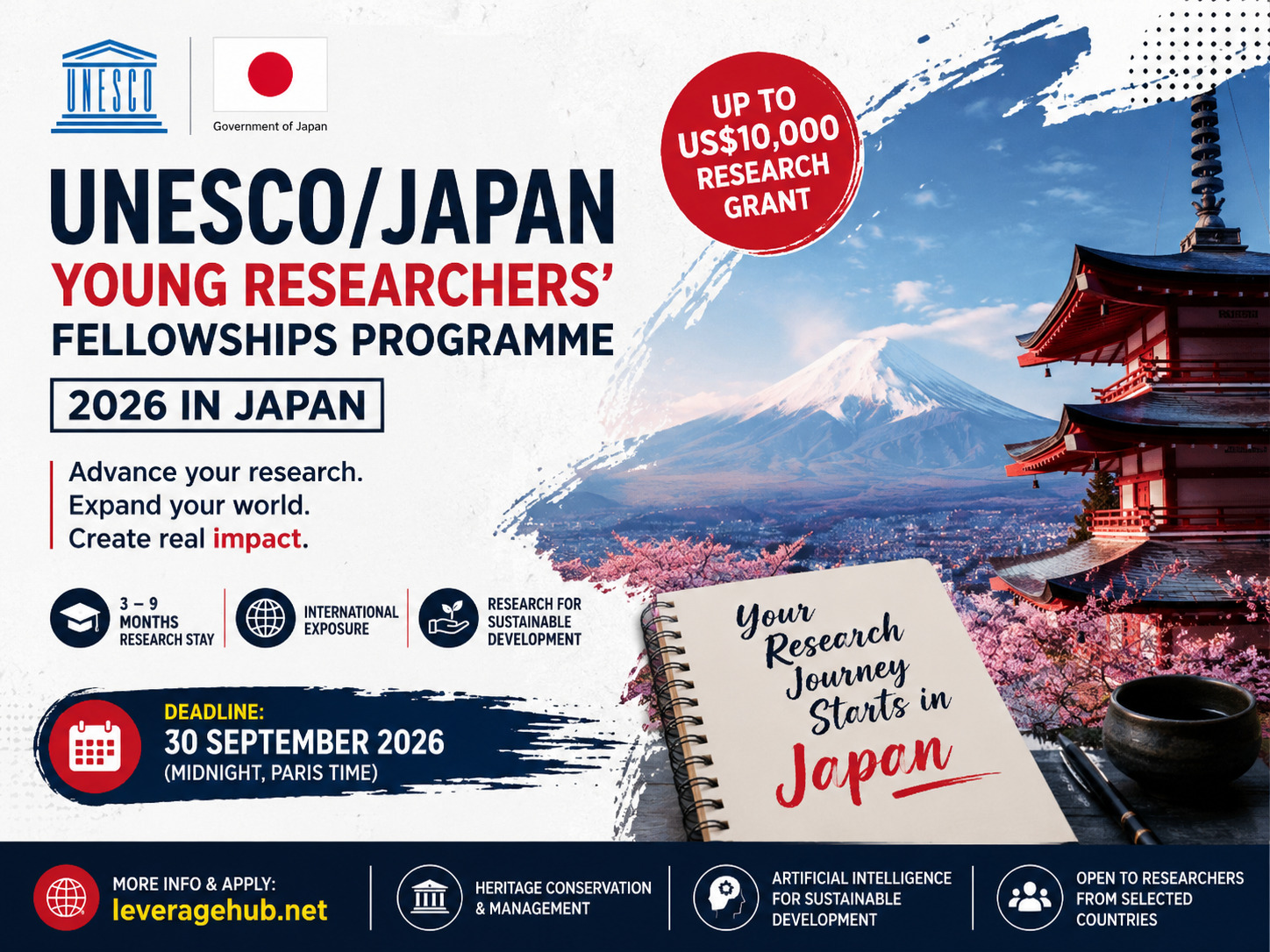
Are you a young researcher looking for an opportunity to conduct advanced research in Japan? The UNESCO-Japan Young Researchers Fellowship 2026 in Japan, also known as the UNESCO/Keizo Obuchi Research Fellowships Programme, is now accepting applications from eligible researchers across selected countries, including Nigeria.
Funded by the Government of Japan and administered by UNESCO, this prestigious fellowship supports promising researchers undertaking postgraduate research in areas that contribute to sustainable development, heritage conservation, and the responsible use of artificial intelligence.
If selected, you could receive up to US$10,000 to support a research stay at a Japanese university or research institution for 3 to 9 months.
Programme Summary
- Host Country: Japan
- Programme: UNESCO/Japan Young Researchers’ Fellowships Programme (UNESCO/Keizo Obuchi Fellowship)
- Funded By: Government of Japan through UNESCO
- Eligible Countries: Selected countries across Africa, Asia-Pacific, Latin America & the Caribbean, Europe, and the Arab States (including Nigeria)
- Research Duration: 3–9 months
- Funding: Up to US$10,000
- Application Deadline: 30 September 2026
- Research Start: From February 2027
- Application Mode: Through your country’s National Commission for UNESCO
About the UNESCO/Keizo Obuchi Fellowship
Established in 2001, the UNESCO/Japan Young Researchers’ Fellowships Programme was created to strengthen research capacity among talented young scholars while promoting international academic collaboration.
The fellowship enables successful applicants to carry out postgraduate research in Japan under the supervision of experienced researchers at recognized Japanese universities and research institutions.
For the 2026 cycle, UNESCO will award 10 fellowships to outstanding young researchers from eligible countries.
The programme focuses on research that addresses global challenges and contributes to UNESCO’s mission of sustainable development and international cooperation.
Fellowship Benefits
Successful fellows may receive funding of up to US$10,000, which can be used to cover:
- International airfare
- Domestic travel within Japan
- Accommodation
- Living expenses
- Medical insurance
- Local transportation
- Approved research-related expenses
The fellowship does NOT cover:
- University tuition fees
- Purchase of computers or equipment
- Publication expenses
- Conference participation (unless approved as an essential component of the research)
UNESCO will arrange mandatory medical insurance for selected fellows, with the insurance cost deducted from the fellowship amount.
Research Areas
Applicants must submit research proposals under one of the approved themes.
1. Heritage Conservation and Management
Possible research topics include:
- Cultural heritage preservation
- Heritage and sustainable development
- Cultural tourism
- Protection of heritage during conflicts
- Digital documentary heritage
2. Artificial Intelligence for Sustainable Development
Examples include:
- AI for climate action
- AI in water resource management
- Flood and drought prediction
- Groundwater assessment
- AI-supported environmental decision-making
Applicants must select one primary research area and an appropriate sub-area when preparing their proposal.
Eligibility Criteria
Applicants must:
- Be nationals of one of the invited UNESCO Member States (Nigeria is eligible)
- Be 40 years old or younger at the time of application
- Hold at least a Master’s degree (or equivalent)
- Demonstrate strong academic and research potential
- Possess adequate language proficiency required by the host institution
- Secure acceptance from an academic supervisor at a Japanese university or research institution before applying
Required Documents
Applicants should prepare:
- Completed application form
- Detailed research proposal
- Academic transcripts and certificates
- Curriculum Vitae (CV)
- Recommendation letter
- Acceptance letter from a Japanese supervisor
- UNESCO Language Knowledge Certificate
- Any additional supporting documents required by UNESCO and the National Commission
How to Apply
Follow these steps:
- Carefully read the official application guidelines.
- Contact your country’s National Commission for UNESCO to understand local application procedures.
- Obtain acceptance from a supervisor at a Japanese university or research institution.
- Complete all required application documents.
- Submit your application to your National Commission for UNESCO at least two weeks before its internal deadline.
- If nominated by the National Commission, submit the online application and supporting documents to UNESCO as instructed.
Only applications officially nominated by a National Commission for UNESCO will be considered.
Application Deadline
30 September 2026 (Midnight, Paris Time)
Applicants are encouraged to submit their documents well before the deadline since National Commissions may have earlier internal closing dates.
Official Application Link
Interested applicants can access the official programme page, application guide, forms, and supporting documents here:
Application Portal: UNESCO/Japan Young Researchers’ Fellowships Programme 2026
Why You Should Apply
The UNESCO/Keizo Obuchi Fellowship offers more than financial support. It provides an opportunity to:
- Conduct research at leading Japanese institutions
- Collaborate with internationally recognized experts
- Expand your academic network
- Develop innovative research with global impact
- Contribute to sustainable development and scientific advancement
For young researchers seeking international exposure and funding, this fellowship represents an excellent opportunity to advance both academic and professional careers.