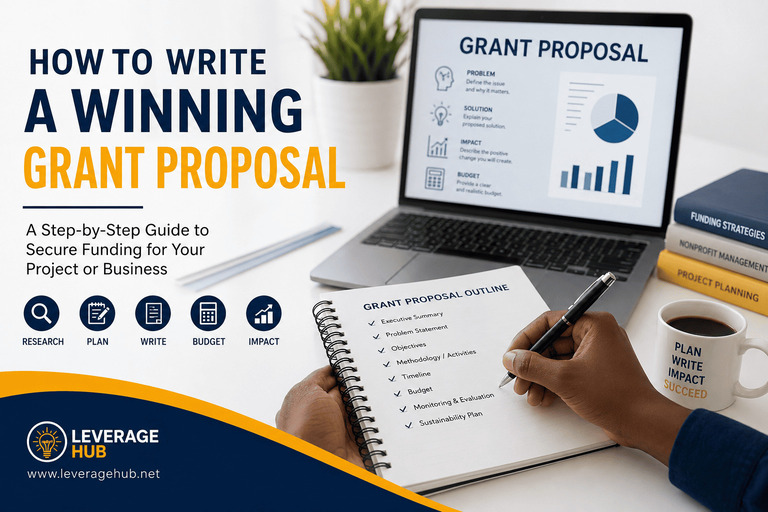
Have you ever found a grant opportunity that looked perfect, spent hours filling out the application, and then never heard back? You are not alone. Many students, entrepreneurs, nonprofits, researchers, and community leaders miss funding opportunities not because their ideas are poor, but because their proposals fail to communicate value clearly.
- Quick Answer / Key Takeaways
- What Is a Grant Proposal?
- Why Learning How to Write a Winning Grant Proposal Matters
- Before You Start Writing
- How to Write a Winning Grant Proposal Step by Step
- Step 1: Write a Clear Project Title
- Step 2: Start With an Executive Summary
- Step 3: Describe the Problem
- Step 4: Present Your Solution
- Step 5: Set SMART Objectives
- Step 6: Create an Activity Plan
- Step 7: Prepare a Realistic Budget
- Step 8: Explain How You Will Measure Success
- Step 9: Demonstrate Capacity
- Step 10: Write a Strong Conclusion
- A Simple Grant Proposal Structure
- Practical Example
- Common Mistakes to Avoid
- Expert Tips That Improve Success Rates
- Recommended Free Resources
- Frequently Asked Questions
- Final Action Plan (Next 24 Hours)
- Conclusion
Learning how to write a winning grant proposal is one of the most valuable skills you can develop. A strong proposal shows funders that you understand a real problem, have a practical solution, can manage funds responsibly, and are likely to achieve measurable results.
Whether you are applying for a scholarship project grant, a small business grant, a community development fund, or an international fellowship, the same core principles apply. In this guide, you will learn a simple step-by-step process, see a realistic example, avoid common mistakes, and leave with an action plan you can start today.
Quick Answer / Key Takeaways
Best for: Students, nonprofits, entrepreneurs, researchers, and social impact projects
Time required: 3–10 hours for a first draft
Ideal length: Follow the funder’s guidelines exactly
Most important section: Problem statement and project impact
Biggest mistake to avoid: Sending the same proposal to every grant provider without customization
What Is a Grant Proposal?
A grant proposal is a written request for funding submitted to a government agency, foundation, company, university, or donor organization. It explains:
- The problem you want to solve
- Why the problem matters
- Your proposed solution
- Activities you will carry out
- Expected results
- Budget and timeline
- How success will be measured
Think of it as a business case for funding. The funder is investing resources, and your proposal must convince them that the investment is worthwhile.
Why Learning How to Write a Winning Grant Proposal Matters
A well-written proposal can help you:
- Fund education or research projects
- Start or grow a business
- Launch a nonprofit initiative
- Support community development programs
- Access international fellowships and innovation funds
- Build credibility with partners and donors
Even if you are not selected, a strong proposal often becomes the foundation for future applications.
Before You Start Writing
Read the Guidelines Carefully
Many applications are rejected before review because applicants ignore instructions. Check:
- Eligibility requirements
- Deadline and time zone
- Required documents
- Word or page limits
- Budget limits
- Format requirements
- Evaluation criteria
Create a checklist and tick off each requirement before submission.
Research the Funder
Visit the organization’s website and review previously funded projects. Ask yourself:
- What causes do they support?
- What geographic areas do they prioritize?
- What type of impact do they value?
- What language do they use to describe their mission?
Use similar terminology naturally in your proposal.
How to Write a Winning Grant Proposal Step by Step
Step 1: Write a Clear Project Title
Good titles are specific and easy to understand.
Weak: Youth Project
Better: Digital Skills Training for 100 Unemployed Youths in Lagos
A strong title immediately tells the reviewer what the project is about.
Step 2: Start With an Executive Summary
Write this section last, even though it appears first.
Include:
- Who you are
- The problem
- The solution
- Amount requested
- Expected impact
Example:
Leverage Youth Initiative seeks ₦2,500,000 to train 100 unemployed youths in Lagos in digital marketing and freelance skills over six months, with a target of at least 40 participants earning income within three months of completion.
Keep it concise and compelling.
Step 3: Describe the Problem
This is often the most important section.
Explain:
- What problem exists
- Who is affected
- Evidence that the problem is real
- Why action is needed now
Use credible statistics from government reports, academic studies, or reputable organizations when possible.
Strong Problem Statement
- Specific
- Evidence-based
- Focused on beneficiaries
- Relevant to the funder’s mission
Avoid emotional exaggeration.
Step 4: Present Your Solution
Describe exactly what you will do.
Use clear activities such as:
- Training workshops
- Mentorship sessions
- Equipment distribution
- Research activities
- Awareness campaigns
- Business incubation support
Explain why your approach will work.
Step 5: Set SMART Objectives
Use objectives that are:
- Specific
- Measurable
- Achievable
- Relevant
- Time-bound
Example
| Weak Objective | Strong Objective |
| Improve digital skills | Train 100 youths in digital marketing within 6 months |
| Help women earn income | Support 50 women to launch micro-businesses within 4 months |
Funders want measurable outcomes.
Step 6: Create an Activity Plan
Present a simple timeline.
| Month | Activity |
| 1 | Recruitment and orientation |
| 2–3 | Training sessions |
| 4 | Mentorship and practical projects |
| 5 | Business support and internship matching |
| 6 | Evaluation and final report |
This shows that your project is organized.
Step 7: Prepare a Realistic Budget
A budget should match your activities.
Example Budget
| Item | Amount |
| Training materials | ₦300,000 |
| Venue and internet | ₦250,000 |
| Facilitators | ₦800,000 |
| Monitoring and evaluation | ₦200,000 |
| Administration | ₦150,000 |
| Equipment | ₦800,000 |
| Total | ₦2,500,000 |
Budget Tips
- Use realistic market prices.
- Explain unusual costs.
- Avoid vague items such as “miscellaneous.”
- Ensure totals are accurate.
Step 8: Explain How You Will Measure Success
Funders want evidence of impact.
Include:
- Number of participants trained
- Attendance rates
- Test scores before and after training
- Jobs created
- Businesses started
- Income increases
- Research outputs
Mention tools such as surveys, attendance sheets, interviews, or financial records.
Step 9: Demonstrate Capacity
Explain why you can deliver the project.
Include:
- Relevant experience
- Team qualifications
- Previous projects
- Partnerships
- Registration status (if applicable)
If you are a first-time applicant, emphasize skills, education, volunteers, mentors, or community support.
Step 10: Write a Strong Conclusion
Reinforce:
- The importance of the problem
- The practicality of your solution
- The expected impact
- Appreciation for the funder’s consideration
Keep the tone confident but respectful.
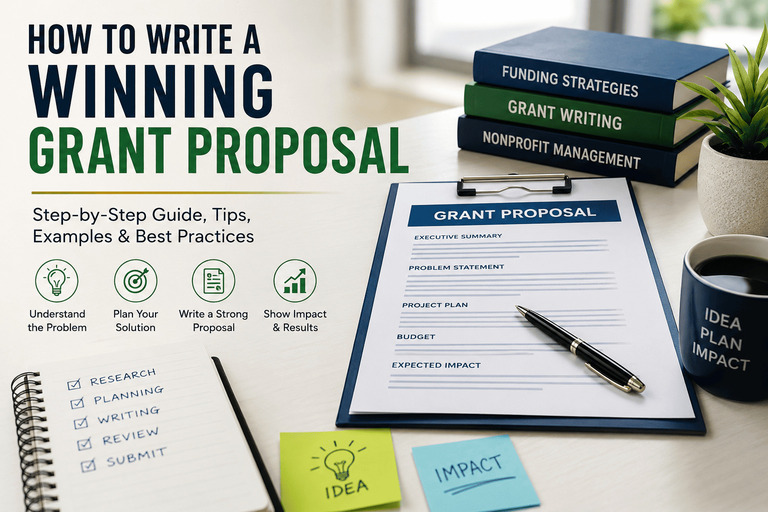
A Simple Grant Proposal Structure
- Cover page
- Executive summary
- Organization or applicant background
- Problem statement
- Project description
- Objectives
- Activities and timeline
- Budget
- Monitoring and evaluation
- Sustainability plan
- Conclusion
- Attachments
Use this as a checklist when drafting.
Practical Example
Scenario: Small Business Grant in Nigeria
Applicant: Ada, a graduate in Lagos
Goal: Start a recycling-based packaging business
Grant Amount: ₦1,200,000
What Made Her Proposal Strong?
- Identified plastic waste as a local environmental problem.
- Showed demand from nearby food vendors for affordable packaging.
- Included a six-month production plan.
- Attached supplier quotations.
- Estimated job creation for three women.
- Explained how sales revenue would sustain the business after the grant.
Ada did not promise to become a millionaire. She presented a realistic, measurable project with clear community benefits.
Common Mistakes to Avoid
- Using One Generic Proposal Everywhere: Customize every application to the funder’s priorities.
- Ignoring Instructions: Wrong file format, missing documents, or exceeding word limits can lead to automatic rejection.
- Weak Problem Statement: Saying “many people suffer” is not enough. Provide evidence and context.
- Unrealistic Budget: Inflated costs reduce credibility.
- Vague Objectives: “Empower youth” is too broad. State numbers and timelines.
- Poor Proofreading: Typos and inconsistent figures suggest carelessness.
- No Sustainability Plan: Explain how activities will continue after the grant ends.
Expert Tips That Improve Success Rates
- Start writing at least 2 weeks before the deadline.
- Use headings that match the application form.
- Write in plain English.
- Use active verbs: train, support, deliver, measure, evaluate.
- Ask another person to review your draft.
- Save all supporting documents in one folder.
- Keep a master CV, organization profile, and budget template for future applications.
Recommended Free Resources
Grant Research
- Official government grant portals
- Foundation websites
- University funding pages
- International development agencies
Writing Support
- Google Docs
- Microsoft Word templates
- Grammarly or similar proofreading tools
Budget Preparation
- Google Sheets
- Microsoft Excel
Learning Platforms
- Free nonprofit management courses
- Entrepreneurship training platforms
- Research proposal writing courses
Always verify opportunities on official websites before applying.
Frequently Asked Questions
How long should a grant proposal be?
Follow the funder’s instructions. Some require one page; others allow several pages.
Can an individual apply for grants?
Yes. Many scholarships, fellowships, research grants, and creative grants accept individual applicants.
Do I need a registered organization?
Not always. Check the eligibility rules. Some grants are open to students, researchers, or entrepreneurs without registered organizations.
What is the most important part of a grant proposal?
Usually the problem statement and expected impact, because they explain why funding is needed.
Should I include statistics?
Yes, when they come from credible sources and directly support your argument.
Can I use AI tools to help write a proposal?
You may use writing tools for brainstorming or editing, but ensure the final proposal is accurate, personal, and fully reviewed by you.
How many grants should I apply for?
Apply for several well-matched opportunities rather than sending one generic proposal to dozens of funders.
What if my proposal is rejected?
Request feedback if available, improve the proposal, and apply again. Many successful grantees were rejected multiple times before receiving funding.
Final Action Plan (Next 24 Hours)
- Find One Suitable Grant: Choose an opportunity that clearly matches your goals and eligibility.
- Create a Proposal Folder: Add the guidelines, your CV, identification documents, certificates, and any supporting materials.
- Draft Three Sections Today: Write the project title, problem statement, and objectives before the day ends.
Taking these small steps immediately is better than waiting for the “perfect” time.
Conclusion
Learning how to write a winning grant proposal is not about using complicated language. It is about communicating a real problem, presenting a practical solution, and proving that you can deliver meaningful results. Funders are looking for clarity, credibility, and impact.
Start by carefully reading the guidelines, researching the funder, defining measurable objectives, and preparing a realistic budget. Review your proposal thoroughly before submission and tailor it to each opportunity.
Remember, every strong proposal improves your skills, even if the first application is unsuccessful. With practice, your proposals will become clearer, more persuasive, and more competitive.
For more scholarship, grant, business, and career resources, explore the practical guides available on LeverageHub.net and continue building the skills that open doors to new opportunities.