If you’re reading this, you’ve probably already had that moment — the one where you’re lying in bed at 1 a.m., mentally listing (Study Abroad Checklist) everything you need to do before you leave, only to forget half of it by morning. That’s normal. Studying abroad is one of the most exciting decisions you’ll ever make, but it’s also one of the most paperwork-heavy, logistics-heavy, “wait, did I forget something?” experiences of your life.
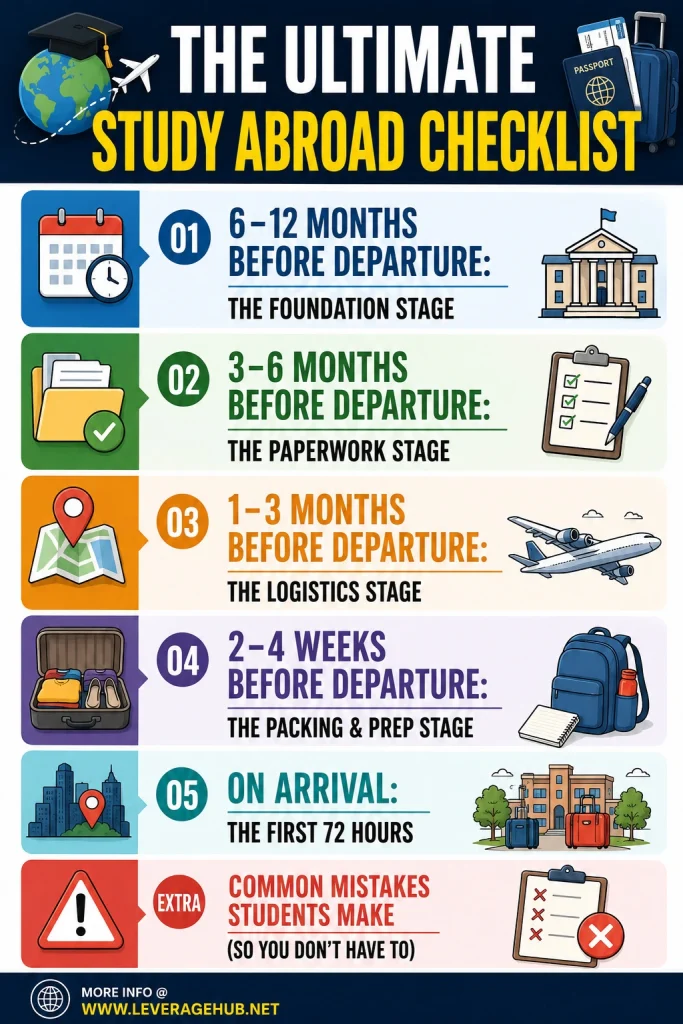
- 6–12 Months Before Departure: The Foundation Stage
- 3–6 Months Before Departure: The Paperwork Stage
- 1–3 Months Before Departure: The Logistics Stage
- 2–4 Weeks Before Departure: The Packing & Prep Stage
- On Arrival: The First 72 Hours
- Common Mistakes Students Make (So You Don’t Have To)
- Frequently Asked Questions (Study Abroad Checklist)
This checklist isn’t the generic “pack a jacket and don’t forget your passport” list you’ve seen a hundred times. It’s organized the way your brain actually needs it — by timeline, not by category — because that’s how the stress really hits: in waves, at different stages.
Let’s get you sorted.
6–12 Months Before Departure: The Foundation Stage
This is the stage where most people either get ahead of the game or fall behind without realizing it. Don’t skip these.
- Research your schools/programs thoroughly. Don’t just look at rankings — look at course structure, faculty, cost of living in the city, and post-study visa options if that matters to you.
- Check entry requirements. Every country and university has different academic and language requirements (IELTS, TOEFL, PTE, or Duolingo English Test are common).
- Take your standardized tests early. Test slots fill up fast, and scores can take weeks to arrive.
- Start your passport application (or renewal) immediately. Processing times vary wildly by country, and delays here can derail everything else.
- Research scholarships and funding options. Many scholarship deadlines are 6–10 months before the program starts, so this isn’t something you can leave for later.
- Draft your Statement of Purpose (SOP) and get feedback. Give yourself time to revise it more than once — a rushed SOP is usually an obvious one.
Also Read: The Exact Scholarship Application Checklist Used by Successful Applicants
3–6 Months Before Departure: The Paperwork Stage
This is where the checklist starts to feel “real.” Documents, documents, and more documents.
- Apply to your university/college and secure your admission letter.
- Start your student visa application as soon as you have your offer letter. Visa processing times can range from a few weeks to several months depending on the country.
- Arrange proof of finances. Most visas require bank statements, sponsorship letters, or education loan sanction letters showing you can support yourself.
- Book your health/travel insurance. Some countries mandate specific insurance providers, so check your destination’s requirements before buying.
- Apply for a student loan (if needed) and understand repayment terms before you sign anything.
- Start accommodation hunting. Whether it’s university housing or private rentals, good places go fast — especially near popular campuses.
- Get your medical check-ups and vaccinations done. Some visas require a medical exam from an approved panel physician.
1–3 Months Before Departure: The Logistics Stage
Now it starts feeling less like planning and more like packing your entire life into boxes (sometimes literally).
- Book your flights. Prices tend to be best 6–8 weeks out, but always compare student fare options — many airlines offer discounted baggage allowances for students.
- Confirm your accommodation and get contracts in writing.
- Set up international banking. Look into student bank accounts in your destination country, and check whether your home bank offers no-fee international transfers.
- Get an international driving permit if you plan to drive.
- Notify your current bank and phone provider about your move, and check international SIM or eSIM options.
- Make copies (physical and digital) of every important document: passport, visa, admission letter, insurance policy, financial documents, vaccination records.
- Register with your home country’s embassy or consulate abroad, if that’s something your government offers — it matters more than people realize in emergencies.
- Start a “pre-departure checklist group chat” with other students heading to the same city or university. You’ll thank yourself later.
2–4 Weeks Before Departure: The Packing & Prep Stage
The finish line is close, and this is where small oversights turn into big headaches.
- Pack smart, not just full. Check baggage weight limits and prioritize essentials — climate-appropriate clothing, chargers/adapters, any prescription medication (with prescriptions translated if needed), and a few home comforts.
- Download offline maps and translation apps for your destination city.
- Save digital and printed copies of key contacts: university international office, emergency contacts, embassy details, insurance provider.
- Arrange airport pickup or figure out transport from the airport to your accommodation.
- Inform your bank of your travel dates so your cards don’t get blocked abroad.
- Set up international health insurance details in your phone so you can access them instantly if needed.
- Say your goodbyes properly. Seriously — don’t rush this part. It matters more than any checklist item.
On Arrival: The First 72 Hours
Your checklist doesn’t end when you land — it just changes shape.
- Complete any mandatory immigration check-ins required by your visa.
- Collect your residence permit or student ID, depending on your country’s process.
- Open a local bank account, if you haven’t already arranged one.
- Get a local SIM card or activate your eSIM.
- Locate your university’s international student office — they exist specifically to help you, so use them.
- Familiarize yourself with public transport and emergency numbers.
- Register your address with local authorities if required (common in several European countries).
Common Mistakes Students Make (So You Don’t Have To)
- Underestimating visa processing times and applying too late
- Not budgeting for the real cost of living, not just tuition
- Skipping travel insurance to “save money”
- Packing too much instead of packing smart
- Forgetting to make copies of important documents
- Waiting until the last minute to sort accommodation
Frequently Asked Questions (Study Abroad Checklist)
How early should I start preparing to study abroad?
Ideally, 9–12 months before your intended departure, especially if scholarships, standardized tests, or competitive programs are involved.
What documents are absolutely essential for studying abroad?
At minimum: valid passport, visa, admission/offer letter, proof of finances, health insurance documents, and academic transcripts.
Do I need travel insurance if I already have health insurance in my home country?
Usually yes. Most countries require destination-specific health insurance that meets local coverage standards, which your home policy likely doesn’t satisfy.
How much money should I have as proof of funds for a student visa?
This varies by country and is usually specified by the immigration authority — it typically covers tuition plus a set amount for living expenses for the first year.
What’s the biggest mistake students make when studying abroad?
Leaving visa applications and accommodation search too late. Both processes often take longer than expected and have limited availability.
Studying abroad is a life-changing chapter, but it’s built on small, unglamorous steps — forms, folders, and follow-ups. Take this checklist one stage at a time, and you’ll land in your new city with far less stress and a lot more excitement to actually enjoy where you are.