Let me be honest with you: the first time someone told me they applied to 100 scholarships in a month, I thought they were exaggerating. Or lying. Or possibly a robot wearing a hoodie.
- Why 100 Scholarships in 30 Days Actually Makes Sense
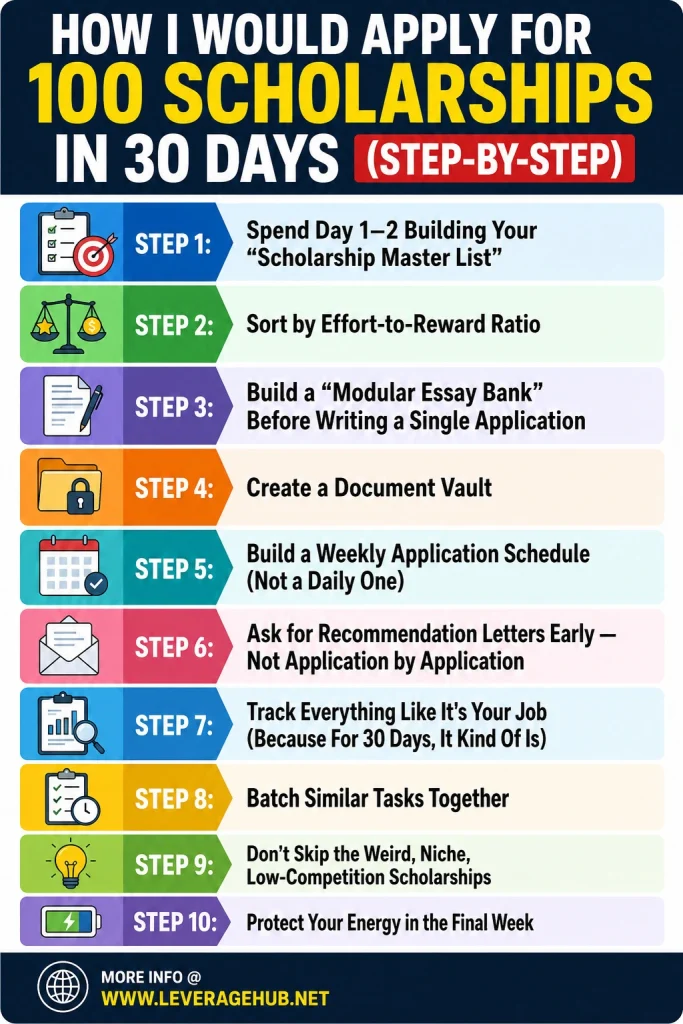
- STEP 1: Spend Day 1–2 Building Your “Scholarship Master List”
- STEP 2: Sort by Effort-to-Reward Ratio
- STEP 3: Build a “Modular Essay Bank” Before Writing a Single Application
- STEP 4: Create a Document Vault
- STEP 5: Build a Weekly Application Schedule (Not a Daily One)
- STEP 6: Ask for Recommendation Letters Early — Not Application by Application
- STEP 7: Track Everything Like It’s Your Job (Because For 30 Days, It Kind Of Is)
- STEP 8: Batch Similar Tasks Together
- STEP 9: Don’t Skip the Weird, Niche, Low-Competition Scholarships
- STEP 10: Protect Your Energy in the Final Week
- A Realistic Expectation to Set Now
- Frequently Asked Questions
Then I sat down, mapped it out on paper, and realized… it’s actually doable. Not easy. Not comfortable. But doable — if you stop treating every application like it’s the first one you’ve ever written.
That’s the whole secret, honestly. Most students burn out after 10 applications because they’re rebuilding their essay from scratch every single time. You can’t do that 100 times. You need a system. So here’s exactly how I’d approach it if I had 30 days and a genuine need to fund my education.
Why 100 Scholarships in 30 Days Actually Makes Sense
Before the “how,” let’s talk about the “why,” because the math matters here.
If you apply to 5 scholarships, your odds of winning even one are painfully low. Scholarship competitions can pull in thousands of applicants for a single award. But if you apply to 100 — especially a mix of small, medium, and niche awards — you’re playing a completely different game. Even average-quality applications, submitted at volume, tend to outperform 3 “perfect” applications you spent three weeks each polishing.
This is a numbers game wrapped around a systems problem. Once I understood that, the whole approach changed.
Also Read: The Exact Scholarship Application Checklist Used by Successful Applicants
STEP 1: Spend Day 1–2 Building Your “Scholarship Master List”
I wouldn’t touch a single application form on day one. Instead, I’d build a master spreadsheet — this becomes the control tower for the entire month.
Columns I’d include:
- Scholarship name
- Amount
- Deadline
- Eligibility requirements
- Essay prompt (if any)
- Required documents
- Application link
- Status (Not Started / In Progress / Submitted)
Where would I find 100+ scholarships fast? A mix of:
- Your school’s financial aid office (they usually have an internal list nobody checks)
- Scholarship databases and search platforms
- Local organizations — Rotary Clubs, community foundations, churches, employers of your parents
- Niche identity-based or major-based scholarships (these have way less competition)
- Your state’s higher education scholarship portal
Aim for volume here. Don’t filter too hard yet. You’re casting a wide net first — you’ll narrow it down in Step 2.
STEP 2: Sort by Effort-to-Reward Ratio
Not all scholarships are created equal, and treating them that way is where most people waste their 30 days.
I’d sort my master list into three buckets:
Bucket A — Low effort, no essay: Just a form, maybe a short paragraph. These are gold. Knock out 10–15 of these in the first week alone.
Bucket B — Medium effort, short essay (under 500 words): These make up the bulk of scholarship applications. This is where your reusable essay bank (Step 3) saves your sanity.
Bucket C — High effort, long essay or portfolio required: Fewer of these, but often bigger dollar amounts. Worth it, but budget more time per application.
This sorting step alone can cut your total workload by 30–40%, because you stop treating a $500 no-essay scholarship the same way you’d treat a $10,000 essay-heavy one.
STEP 3: Build a “Modular Essay Bank” Before Writing a Single Application
This is the actual unlock. Here’s the thing nobody tells you: most scholarship essay prompts are asking variations of the same five or six questions.
- Tell us about yourself / your background
- Describe a challenge you’ve overcome
- What are your career goals?
- Why do you deserve this scholarship?
- How will this scholarship help you achieve your goals?
- Describe your community involvement or leadership experience
So instead of writing 100 unique essays, I’d write 5–6 strong, detailed “core essays” — one for each theme — around 600–800 words each. Then, for each application, I’d trim, tweak, and re-tailor the closest matching core essay to fit that specific prompt and word count.
This single move is what makes 100 applications realistic instead of insane. You’re not writing 100 essays. You’re remixing 6.
STEP 4: Create a Document Vault
Scholarship committees love asking for the same supporting documents over and over. I’d prepare these once, upfront, so I’m never scrambling mid-month:
- Unofficial and official transcripts (get several copies)
- A general recommendation letter template you can share with recommenders
- Your resume or activity list, scholarship-formatted
- A headshot (some applications request one)
- Proof of enrollment or acceptance letter
- FAFSA Submission Summary, if income-based scholarships require it
Having these ready in one folder means each application takes minutes instead of hours to assemble.
STEP 5: Build a Weekly Application Schedule (Not a Daily One)
Trying to submit 3–4 applications every single day for 30 straight days is a fast track to burnout. Instead, I’d break it down weekly:
- Week 1: Research + master list + core essays (Steps 1–3). Submit 10 Bucket A applications as a warm-up.
- Week 2: 25 applications — mostly Bucket B, using the essay bank.
- Week 3: 30 applications — mix of B and C, plus recommendation letter follow-ups.
- Week 4: Remaining 35 applications, prioritizing upcoming deadlines and higher-dollar Bucket C awards.
This gives early weeks room to build the system, and back-loads volume once the machine is running.
STEP 6: Ask for Recommendation Letters Early — Not Application by Application
If I waited to request a letter every time a scholarship needed one, I’d lose entire days to awkward emails and waiting periods. Instead, in Week 1, I’d ask 2–3 teachers or mentors for a general letter of recommendation I can reuse across multiple applications, along with permission to request small tweaks later if a specific scholarship needs it.
STEP 7: Track Everything Like It’s Your Job (Because For 30 Days, It Kind Of Is)
That spreadsheet from Step 1 isn’t optional — it’s what keeps 100 moving parts from turning into chaos. I’d update it daily: what’s submitted, what’s pending, what needs a follow-up, and what’s coming due next.
I’d also set calendar reminders 3 days before each deadline, because “I’ll do it this weekend” has ended more scholarship dreams than rejection letters ever have.
STEP 8: Batch Similar Tasks Together
Instead of doing one full application start-to-finish, then the next, I’d batch by task type:
- One session just filling out basic info forms across 10 applications
- One session just tailoring essays
- One session just uploading documents and submitting
Batching like this reduces the mental switching cost and honestly makes the whole process feel less exhausting.
STEP 9: Don’t Skip the Weird, Niche, Low-Competition Scholarships
The “Left-Handed Student Scholarship” isn’t a joke — oddly specific scholarships exist, and they get far fewer applicants than the big-name $10,000 awards everyone piles onto. I’d deliberately hunt for scholarships tied to my hobbies, heritage, part-time job, town, or even my parents’ employers. Less competition means better odds, even with a smaller reward.
STEP 10: Protect Your Energy in the Final Week
By week 4, decision fatigue is real. I’d keep a short list of “easy wins” saved for the last few days — quick, no-essay applications I can knock out when I’m mentally drained but still have deadlines to hit.
A Realistic Expectation to Set Now
Not all 100 will get submitted perfectly, and that’s fine. Some will get cut once you realize you’re not eligible. Some deadlines will shift. The goal isn’t a flawless 100 — it’s a system that lets you submit as many strong, genuine applications as possible without collapsing halfway through the month.
Even landing 3–5 scholarships out of 100 applications can meaningfully change what you pay for school. That’s the actual win.
Frequently Asked Questions
Is it realistic to apply to 100 scholarships in 30 days?
Yes, if you build reusable core essays and a document vault first instead of starting every application from scratch. The bottleneck isn’t time — it’s repeating work you don’t need to repeat.
How many scholarships should a student realistically apply to?
There’s no fixed number, but volume matters because scholarship competitions are unpredictable. Applying to 50–100 gives you meaningfully better odds than applying to just a handful.
Can I reuse the same essay for multiple scholarships?
You can reuse the core structure and message, but you should always tailor the opening, word count, and specific details to match each prompt. Generic copy-paste essays are usually easy for reviewers to spot.
What’s the biggest time-waster when applying to scholarships?
Rewriting essays from scratch and re-requesting documents one at a time. Building a document vault and an essay bank upfront removes both problems.
Do smaller, niche scholarships matter if the award amount is low?
Yes. Niche scholarships usually have far less competition, and the amounts add up. Winning five $500 awards is the same as winning one $2,500 award.